
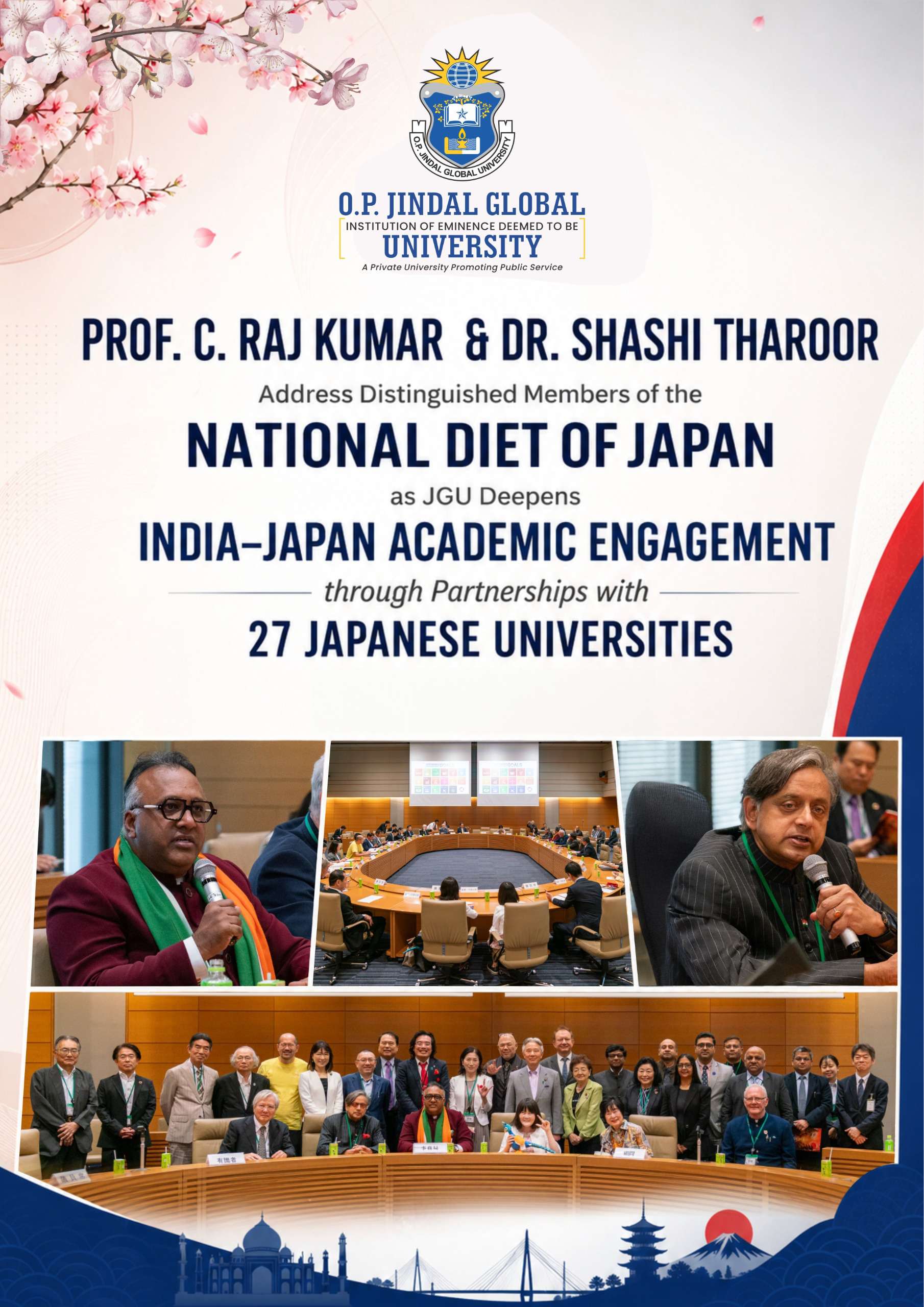
1 July 2026 | Tokyo, Japan: In a rare honour reflecting the growing depth, maturity, and strategic importance of India–Japan relations, Professor C. Raj Kumar, Founding Vice Chancellor of O.P. Jindal Global University (JGU), and Dr. Shashi Tharoor, Member of Parliament, India, addressed a distinguished bipartisan gathering of Members of the National Diet of Japan at the National Diet Building in Tokyo. Their addresses highlighted the complementary roles of higher education and parliamentary diplomacy in advancing one of Asia’s most important democratic partnerships through research, innovation, academic collaboration, and people-to-people engagement.
The significance of the interaction was heightened by coinciding with the official visit of the Prime Minister of Japan Ms Sanae Takaichi to India and the India–Japan Annual Summit with Prime Minister Narendra Modi. As both governments continue to deepen their Special Strategic and Global Partnership at the highest political level, the discussions in Tokyo demonstrated that enduring bilateral relationships are strengthened not only by governments but also by parliaments, universities, scholars, students, industry, and civil society.
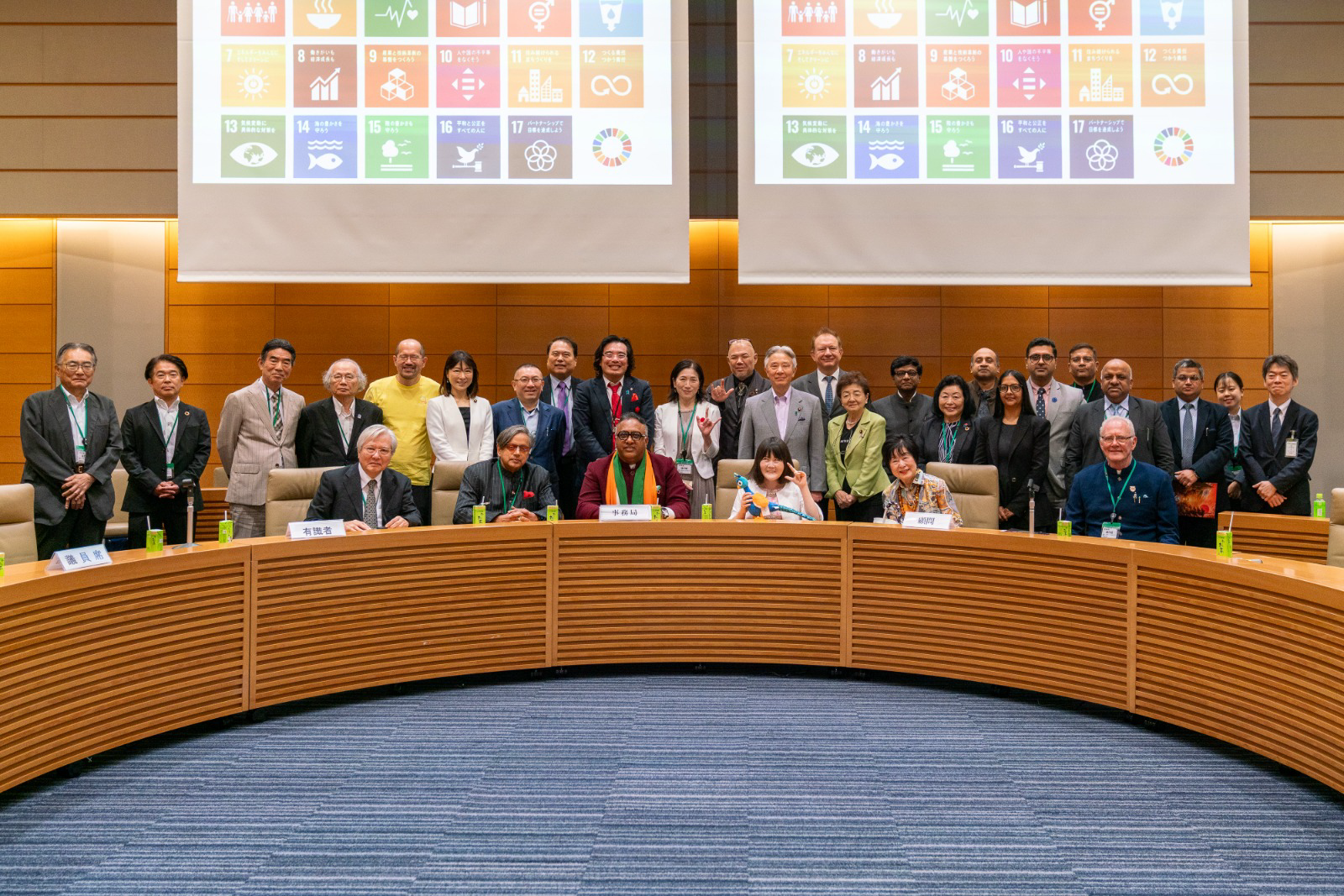
The interaction was chaired by Mr. Fukushiro Nukaga, the 80th Speaker of the House of Representatives of Japan, and brought together an exceptional and bipartisan gathering of Members of the National Diet representing both the House of Representatives and the House of Councillors. The meeting was attended by senior parliamentary leaders, former ministers, government representatives, eminent diplomats, distinguished academics, policy experts, and industry leaders from across Japan. The breadth of participation reflected Japan’s strong bipartisan commitment to strengthening parliamentary dialogue, educational cooperation, democratic engagement, innovation, and institutional partnerships with India.
Professor C. Raj Kumar spoke of the indispensable role of universities in shaping the future of international relations. He observed that institutions of higher learning today are far more than centres of education. They are global platforms where ideas cross borders, innovation flourishes, research addresses common challenges, and future leaders learn to work together across cultures and nations.
“Asia’s evolving geopolitical landscape demonstrates that the strongest international partnerships are patiently built through sustained investments in education, research, technology, human capital, institutional cooperation, and innovation. India and Japan, he said, possess a unique opportunity to deepen their relationship further by investing in universities, scientific collaboration, entrepreneurship, academic mobility, and knowledge partnerships,” He said. He called for a future in which Indian and Japanese universities work even more closely together, researchers jointly address global challenges, students move more freely between both countries, and governments, industry, and academia collectively develop solutions for the Indo-Pacific and beyond. Such investments, he argued, create relationships that are resilient because they are founded not only on policy but also on people.
Highlighting JGU’s own engagement with Japan, Professor Raj Kumar noted that the University’s partnerships with 27 leading Japanese institutions and the participation of nearly 200 students in study abroad programmes across Japan reflect a sustained institutional commitment to building long-term academic cooperation. These partnerships have strengthened student mobility, faculty collaboration, joint research, innovation, and intercultural understanding, demonstrating how universities can serve as enduring bridges between nations.
Professor Raj Kumar observed that higher education has become one of the defining pillars of contemporary India–Japan relations because universities cultivate trust, mutual understanding, leadership, and lifelong friendships that strengthen bilateral cooperation across generations.
Concluding his address, Professor Raj Kumar remarked that if the 20th century laid the foundations of trust between India and Japan, the 21st century must become one in which that trust is transformed into a comprehensive partnership driven by knowledge, technology, sustainability, innovation, entrepreneurship, and shared democratic values. Sharing the platform with Dr. Shashi Tharoor, he described the occasion as a powerful affirmation of the complementary roles that higher education and parliamentary diplomacy can play in advancing one of Asia’s most significant strategic partnerships.
Dr. Shashi Tharoor reflected on the equally important role of parliamentary diplomacy and observed that diplomacy is not merely about negotiating interests or responding to crises. At its finest, he said, diplomacy preserves memory, reflects mutual respect, and inspires nations to imagine and build a better future together.
Reflecting on the centuries-old relationship between India and Japan, Dr. Tharoor said, “The friendship between the two countries has been nurtured through Buddhism, cultural exchange, democratic values, and deep civilisational respect. This shared history, is not only a source of pride but also a responsibility. The challenge before both nations is not to create a new friendship but to continually renew and strengthen an enduring one through institutions capable of serving future generations. While governments create strategic partnerships, it is ultimately people who sustain them. The future of India–Japan relations will depend as much upon the relationships built among students, scholars, parliamentarians, entrepreneurs, artists, innovators, scientists, and citizens as upon agreements signed by governments. These enduring human connections transform strategic cooperation into lasting partnership.”
Members of the National Diet spoke warmly of their longstanding engagement with India and expressed admiration for India’s civilisational heritage, democratic traditions, constitutional institutions, economic transformation, and expanding global role. They reaffirmed their commitment to strengthening parliamentary exchanges, educational partnerships, academic collaboration, scientific research, innovation, and people-to-people ties between the two democracies.
The discussions reflected a shared conviction that the future of India–Japan relations will not be shaped solely by diplomacy, economics, or security cooperation but equally by the strength of democratic institutions, universities, research collaborations, cultural understanding, and the opportunities created for young people to learn from one another.
At a time when India and Japan are engaging at the highest political level to shape the future of their Special Strategic and Global Partnership, the interaction in Tokyo served as a timely reminder that governments alone cannot build enduring international relationships. Universities, parliaments, scholars, researchers, entrepreneurs, and civil society together provide the institutional foundations that enable strategic partnerships to flourish across generations.
The addresses delivered by Professor C. Raj Kumar and Dr. Shashi Tharoor marked another important milestone in the expanding relationship between India and Japan. They reaffirmed the central role of democratic institutions, higher education, research, innovation, and people-to-people engagement in advancing peace, prosperity, sustainability, and stability across the Indo-Pacific and beyond.
Distinguished Participants
The interaction was chaired by Mr. Fukushiro Nukaga, the 80th Speaker of the House of Representatives of Japan, and brought together an exceptionally distinguished and bipartisan gathering of Members of the National Diet of Japan, senior parliamentary leaders, former ministers, government representatives, policy experts, academics, and industry leaders.
They included the Chairperson, Mr. Fukushiro Nukaga, 80th Speaker of the House of Representatives of Japan
Liberal Democratic Party (LDP), House of Representatives
Ms. Toshiko Abe – Former Minister of Education, Culture, Sports, Science and Technology; Mr. Kiyoshi Odawara – Former State Minister for Foreign Affairs; Mr. Hakubun Shimomura – Former Minister of Education, Culture, Sports, Science and Technology; Mr. Yasuhide Nakayama – Director-General, Global South Strategy Headquarters; Mr. Hisayuki Fujii – Former State Minister for Foreign Affairs; Mr. Masahito Moriyama – Former Minister of Education, Culture, Sports, Science and Technology; Mr. Tadamori Fujisawa – Member, House of Representatives.
The House of Councillors representatives included: Dr. Kuniko Inoguchi – Former Minister of State; Former Ambassador Extraordinary and Plenipotentiary; Head of the Delegation of Japan to the Conference on Disarmament;
Proxy Representatives (House of Representatives) included Ms. Hina Iwasaki – Representing Hon. Hina Iwasaki; Mr. Kentaro Uesugi – Representing Hon. Kentaro Uesugi; Ms. Marina Nagata – Representing Hon. Marina Nagata.
From the Democratic Party for the People (DPFP), House of Representatives included Mr. Satoshi Asano.
Proxy Representatives (House of Councillors) included Mr. Takanori Kawai – Representing Hon. Takanori Kawai; Mr. Michiya Haga – Representing Hon. Michiya Haga; Mr. Yoshihiko Yamada – Representing Hon. Yoshihiko Yamada.
Centrist Faction (Chūdō), House of Representatives: Mr. Junya Ogawa – Party Leader and Vice Chairman (Representing Hon. Junya Ogawa)
Constitutional Democratic Party of Japan (CDPJ), House of Councillors: Ms. Ayaka Shiomura; Mr. Shunichi Mizuoka – Party Leader and Vice Chairman; Ms. Masako Mori.
Japan Innovation Party (Nippon Ishin no Kai); House of Councillors: Mr. Kenta Aoshima; Ms. Yukiko Kada
Komeito, House of Councillors: Mr. Masaaki Taniai, Proxy Representative; Ms. Toshiko Takeya – Party Leader and Vice Chairman (Representing Hon. Toshiko Takeya)
Sanseito, House of Representatives: Ms. Hitomi Aoki, Ms. Rina Yoshikawa.
Team Mirai, House of Representatives: Mr. Noboru Usami
Independent (Former NHK Party), House of Councillors: Mr. Kenichiro Saito
Senior Parliamentary Leaders: Ms. Akiko Santo – Advisor and 32nd President of the House of Councillors; Mr. Tetsuro Fukuyama – Vice President of the House of Councillors
Government Representative: Mr. Kosei Nomura – Deputy Minister and Director-General, Ministry of Foreign Affairs
Distinguished Officials, Diplomats, Academics and Experts included:
Mr. Mitsuo Ohashi – Chairman, World Federalist Movement of Japan; Former Chairman of Keidanren and Showa Denko (now Resonac)
Mr. Tadamichi Yamamoto – Former Special Representative of the United Nations Secretary-General; Former United Nations Under-Secretary-General; Former Ambassador to UNESCO; Member, Expert Advisory Body of the Japanese Parliamentary Committee for World Federation
Ms. Hirari Sato – Goodwill Ambassador for the UN Singers
Professor Shiro Takahashi – Reitaku University; Former Advisor to Prime Minister Shinzo Abe
Mr. Shumei Matsuzaki – Executive, Freemason Lodge; Former Advisor to Hirofumi Nakasone, Former Minister for Foreign Affairs Mr. Takahiro Niwa – Special Advisor to Dentsu
Mr. Tamotsu Nakamura – Advisor to Hakuhodo
The Organisers were Mr. Masakuni Tanimoto – Secretary-General, Japanese Parliamentary Committee for World Federation; Chairperson, International Committee for World Federation and the Members of the Secretariat – Japanese Parliamentary Committee for World Federation
